
A middle school student opens the e-ASSR platform for the first time, starts a series of twenty timed questions, and finds themselves stuck on the third video with a scenario involving smartphone distraction. The situation is commonplace, and this is precisely where the difference between superficial training and solid preparation on the day of the official exam lies.
Questions on distractors: the trap that middle school students underestimate at the ASSR
Since the 2022 session, the proportion of questions regarding distractors (smartphone, headphones, social media) has significantly increased in the e-ASSR series. This evolution reflects the rise in accidents related to inattention among young road users.
Specifically, there are videos where a pedestrian crosses while looking at their phone, or a cyclist rides with headphones on. The difficulty does not lie in the rule itself (everyone knows it’s dangerous), but in the precise identification of the infraction in the video sequence. One must identify which behavior is problematic among several visible elements on the screen.
To prepare for this, it is recommended to specifically select the “distractors” theme on the e-ASSR platform and to redo the sequences until the analysis reflex is automatic. Many students review signage and priorities but neglect this theme, even though it now represents a notable proportion of the questions.
To fully understand how the platform works and pass the exam on e-ASSR road safety education, one must first master navigation between training modes and test modes, which do not follow the same logic at all.

ASSR training in class or at home: what really changes for the result
Academic evaluations conducted in 2022-2023 showed a significant gap: students who had at least one supervised session in class achieve better results than those who only trained alone at home. This is a factual observation, not an abstract recommendation.
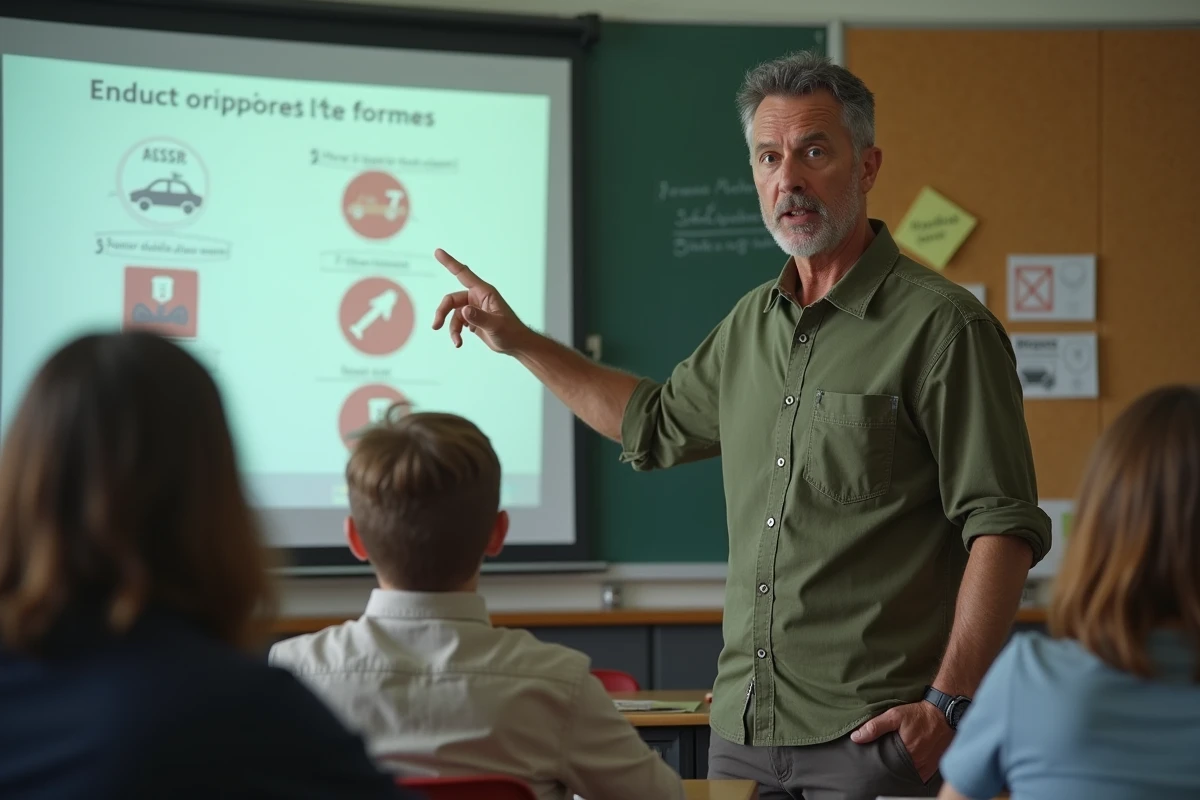
The reason lies in the correction format. In class, the teacher projects the video, each student responds, and then the correction is discussed collectively. This oral explanation process anchors reasoning much better than a simple “correct/incorrect” display on a personal screen.
What can be replicated alone at home
If the school only schedules one session, it is still possible to compensate by imposing a precise discipline at home:
- Use the “Test Yourself” mode on the platform (twenty timed questions) at least three times before the exam, noting the themes where mistakes recur.
- Rewatch each failed video with the “Practice” mode, which displays the commented correction after each question, not just at the end.
- Space out sessions over several days rather than concentrating everything the day before, because memorization of video scenarios works better with distributed revisions.
Feedback varies on this point, but most students who fail acknowledge having only done one test session without revisiting their mistakes.
Rotation of e-ASSR videos: why learning “by heart” no longer works
Since the platform’s overhaul at the start of the 2023 school year, training sessions use the same video bank as the official tests, with regular rotation of sequences. In other words, the platform no longer offers a fixed stock of twenty videos that could be memorized in a loop.
This change has a direct consequence on the revision method. Previously, some students learned the answers by position (“question 7 = answer B”) without understanding the reasoning. This strategy no longer holds.
The correct approach is to reason by theme rather than by video. On the platform, one can select one or more themes from: traffic, speed, equipment, passengers, civic behavior, sustainable development, distractors, first aid, health, and risky behaviors. By working theme by theme, one builds a reflex of analysis applicable to any new sequence.
ASSR level 1 and level 2: adapting preparation to the right exam
ASSR 1 takes place in the fifth grade and opens access to the BSR (AM license) to drive a moped from the age of 14. ASSR 2, taken in the ninth grade, is mandatory for registering for the driving license. Both tests consist of twenty video questions, but the complexity level of the road scenarios differs.
In ASSR 1, the situations mainly involve pedestrians and cyclists in a simple urban environment. In ASSR 2, scenarios include motorized vehicles, complex intersections, questions about blood alcohol levels, and legal penalties.
What this changes for revisions
For ASSR 1, focus the work on the “traffic” and “equipment” themes (bike helmet, visibility vest). For ASSR 2, add the themes “health and risky behaviors” and “first aid,” which often pose problems for ninth-grade students.
- ASSR 1: emphasize the rules for pedestrians and cyclists, basic signage, and low-speed braking distances.
- ASSR 2: work on concepts of blood alcohol levels, drug use while driving, the driver’s legal responsibility, and first aid gestures.
- For both levels: do not neglect the “sustainable development” theme, which regularly appears with questions about carpooling, public transport, or polluting emissions.
On the e-ASSR platform, one directly selects the corresponding test (ASSR1 or ASSR2) before choosing themes, which filters the video sequences suitable for the correct level.
The passing threshold remains set at the majority of correct answers out of the twenty questions. With three to four serious training sessions, spaced over one to two weeks, and a careful review of each commented correction, most middle school students obtain their road safety certificate without difficulty. The real risk is to consider the test as a formality and not to open the platform before the big day.