
Remote work is not just about a choice of logistical comfort. Recent data from Insee and Dares confirm that this mode of work remains very unevenly distributed among professional categories, and that the hybrid model is becoming the norm in France. Succeeding in remote work requires mastering levers that most mainstream guides overlook: contractual framing, managerial signals, and the trade-off between visibility and productivity.
Legal framework for remote work in France: what the charter really imposes
Remote work is based on a precise contractual foundation. Without a collective agreement or a unilateral charter from the employer, the employee has no acquired right to work remotely. The charter sets the time slots for availability, the terms for covering professional expenses, and the conditions for reversibility.
The right to disconnect, enshrined in the Labor Code, fully applies to remote work. We observe that many employees are unaware of it or do not dare to exercise it for fear of appearing disengaged. The charter should specify the time slots during which no professional solicitation can be required.
Occasional remote work falls under the employer’s management authority. A one-time refusal does not need to be justified in the same way as a refusal for regular remote work. This distinction, often blurred in practice, deserves clarification right from the negotiation of the contract or amendment. To delve deeper into contractual modalities and associated training, the remote work offer on OK Formation details the skills to acquire to secure this framework.
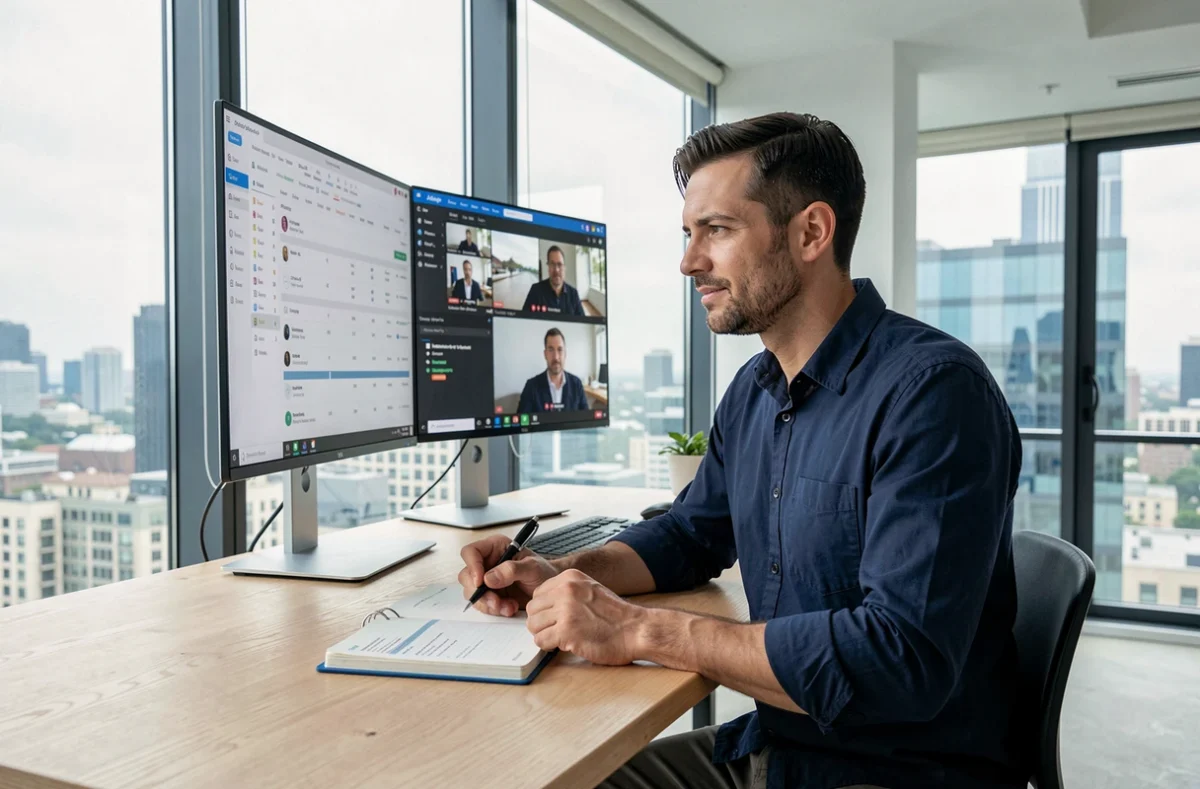
Remote work and career: the trap of professional invisibility
Working remotely several days a week mechanically reduces informal interactions with management. These hallway exchanges, these impromptu lunches with a department head are, however, an underestimated lever for progression.
Professional visibility is actively built in remote work. Waiting for the manager to notice your contributions from a distance is a losing strategy. We recommend formalizing your deliverables in concise reports sent at regular intervals, rather than multiplying instant messages that get lost in the flow.
Apec reports that the vast majority of companies did not change their remote work policy in 2025, but that the limitation on the number of days has been progressing since 2022. This trend reflects an employer’s desire to maintain team cohesion and, indirectly, to preserve the mechanisms of internal promotion that rely on physical presence.
Professional review and remote work
The annual review becomes a pivotal moment for the remote worker. Prepare a structured document listing your achievements, the skills developed, and the cross-functional projects you have contributed to. In the absence of daily visibility, the review is your main tool for showcasing your value.
Internal or external recruiters also assess the ability to collaborate remotely. Mentioning in your application your mastery of specific collaborative tools (video conferencing, asynchronous project management, shared documentation) is no longer a bonus but a prerequisite.
Remote management: detecting overload before burnout
The most underestimated professional risk of remote work does not concern the ergonomics of the workstation. Managers struggle to identify overload and discomfort remotely. Data reported in 2026 indicate that a significant portion of supervisors believe that remote work complicates their mission to detect weak signals.
In-person, a tired employee can be identified by their posture, their silences in meetings, their isolation at the coffee machine. Remotely, these indicators disappear. The manager must then rely on digital signals:
- Sudden changes in connection times (emails sent late at night or very early in the morning on a recurring basis)
- Decreased active participation in video conferences, camera consistently turned off without technical reason
- Lengthening response times on topics usually handled quickly
We observe that teams that function best in hybrid mode establish a weekly individual check-in of fifteen minutes, focused on workload rather than reporting. This managerial ritual replaces the daily micro-interactions of the office.

Digital tools in remote work: balancing synchronous and asynchronous
The proliferation of communication tools paradoxically hinders productivity. Each added synchronous tool generates additional interruptions. Instant messaging, designed to streamline exchanges, often creates a pressure for constant responsiveness that is incompatible with deep work.
The trade-off to be made is clear: reserve synchronous (video, call, chat) for urgent decisions and immediate coordination, and shift everything else to asynchronous (shared documents, structured discussion threads, grouped emails). This collective discipline is not improvised; it is formalized in the charter or in team rules.
Job search and remote skills
Companies hiring for remote work now evaluate candidates’ digital maturity. During a remote job interview, your ability to manage technical tools (lighting, framing, audio quality) directly reflects your ease in a real work situation.
Profiles that document their remote work methodology in their application stand out. Specifying how you structure your professional life between on-site days and home days, which tools you prioritize, and how you maintain connections with your colleagues adds concrete value for the recruiter.
The hybrid model is firmly establishing itself in the French professional landscape. Employees who make the most of it are those who master both the legal framework, asynchronous collaboration tools, and the mechanisms of professional visibility at a distance. Remote work does not erase the codes of career progression; it shifts them towards written communication skills and formalization that few training programs still incorporate.