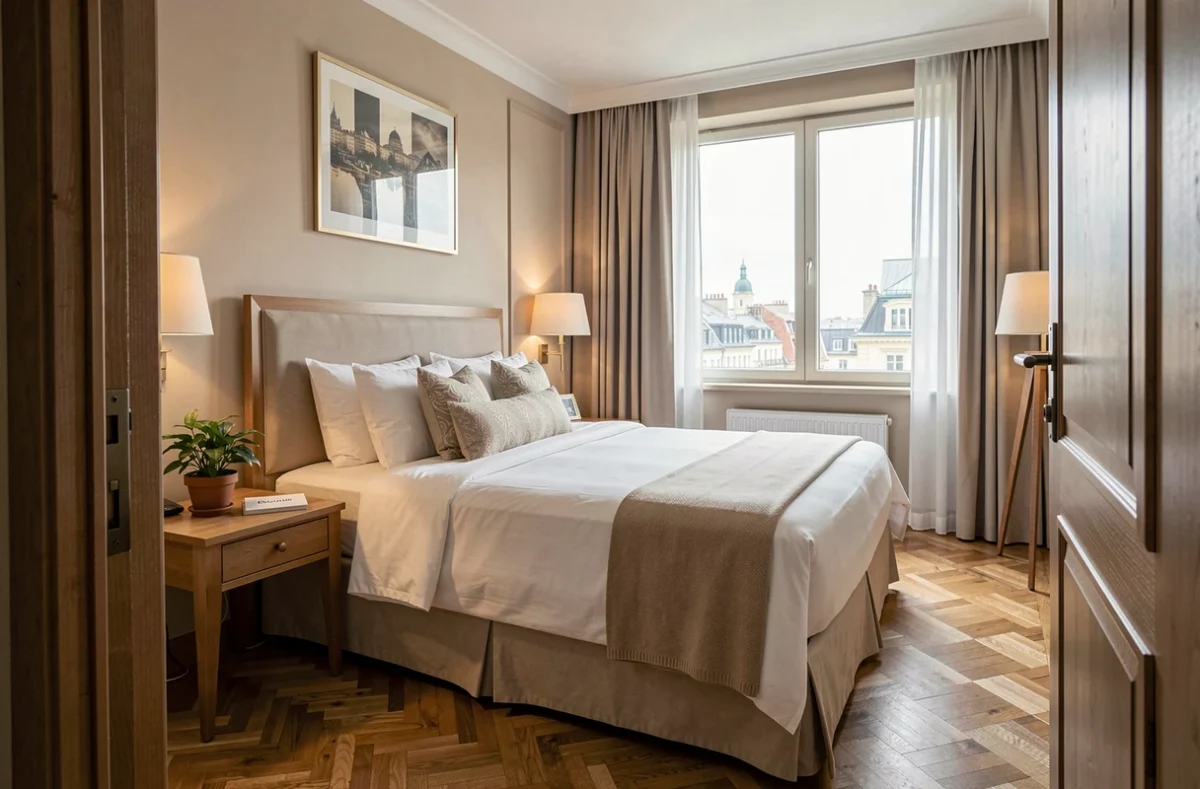
Bed and breakfasts and hotels refer to two distinct types of accommodation under French law, with different obligations, capacities, and business models that have almost nothing in common. Understanding what separates these two options before booking helps avoid misunderstandings regarding the level of service, the actual price of the night, or recourse in case of disputes.
Tourist tax and displayed price: what the bill doesn’t always reveal
The price displayed on a booking platform does not reflect the final cost of a night’s stay. The tourist tax, collected by the municipality, varies according to the classification of the accommodation and the chosen destination.
Unclassified accommodations are generally subject to a local rate between 1% and 5% of the price of the night, with a ceiling set by municipal deliberation. Therefore, two establishments with the same rate can generate very different tax amounts depending on the municipality.
For classified hotels, the rate is flat per person and per night, indexed to the number of stars. A traveler comparing prices between a three-star hotel in Lyon and an unclassified bed and breakfast in the Luberon is not comparing the same tax base. The differences between a bed and breakfast and a hotel also play out in these billing lines often discovered upon arrival.
Booking platforms sometimes collect the tax on behalf of the host, sometimes not. When booking directly with a bed and breakfast, the tax is almost always paid on-site. This discrepancy creates frequent confusion regarding the total price.

Accommodation capacity and regulatory framework: two incompatible logics
French regulation draws a clear line. A bed and breakfast must remain within the limit of 5 rooms and 15 people accommodated simultaneously. Beyond that, the activity shifts to a regime comparable to that of hotels, with increased obligations regarding fire safety and accessibility.
A hotel, on the other hand, has no ceiling on the number of rooms. Establishments range from a few units to several hundred, with a star classification awarded according to a national reference controlled by Atout France.
Administrative formalities to open a bed and breakfast
Opening a bed and breakfast requires prior declaration at the town hall. This step does not exempt one from registration through the single business window or from complying with local urban planning rules. If the property is in co-ownership, the co-ownership regulations may prohibit the activity.
A hotel, however, falls under the regime of establishments receiving the public (ERP). The constraints relate to the safety commission, PMR accessibility standards, price display, and maintaining a police register. The administrative obligations of a hotel are vastly different from those of a bed and breakfast.
Hotel performance by category: classification changes the game
Recent data shows that not all categories of hotels behave the same way in response to fluctuations in attendance. Four and five-star hotels have fared better than unclassified establishments, the latter having recorded a decrease in overnight stays in the fourth quarter of 2025 while the entire hotel industry was progressing.
This observation has a direct implication for travelers. An unclassified hotel does not guarantee a better value for money than a well-maintained bed and breakfast. The absence of classification means the absence of external control over the level of service. Field feedback varies on this point: some unclassified accommodations offer impeccable service, while others struggle to justify their rates.
For bed and breakfasts, there is no mandatory classification system equivalent to hotel stars. Voluntary labels (Gîtes de France, Clévacances) offer evaluation grids, but their coverage remains partial, and their methodology varies.
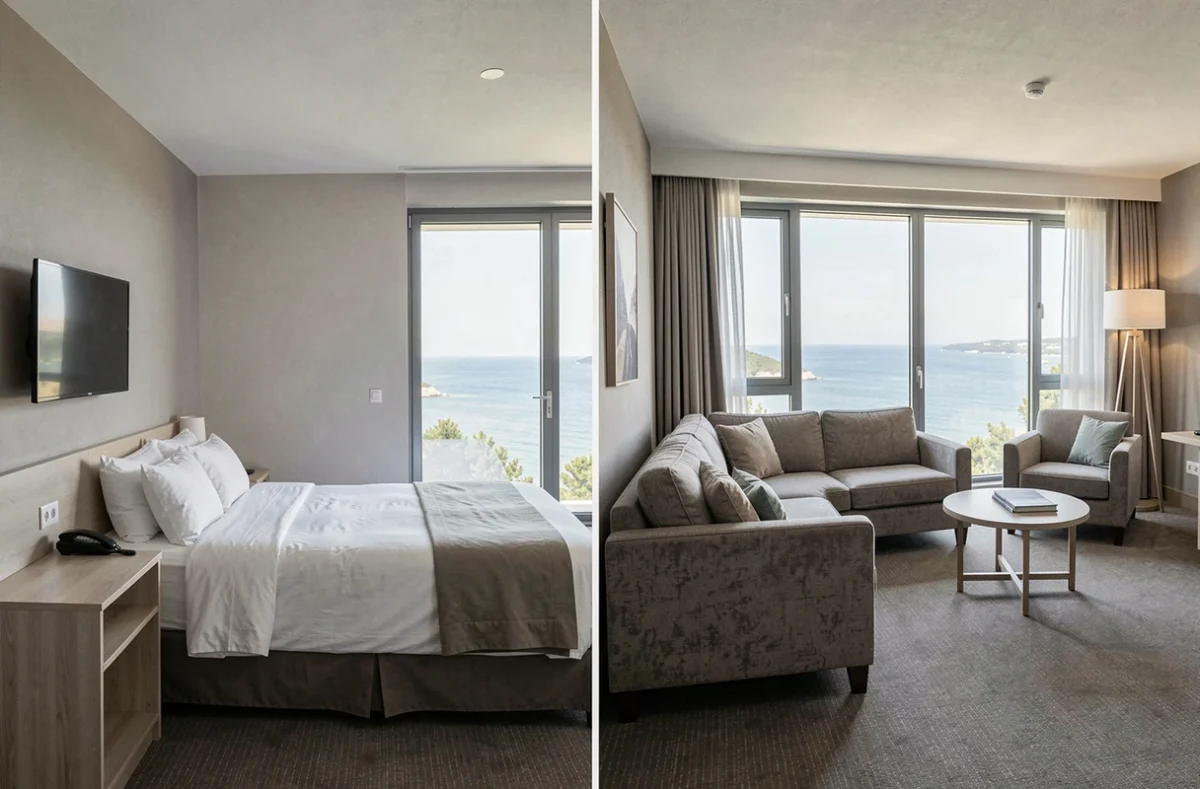
Concrete criteria for choosing between bed and breakfast and hotel
The choice depends less on an abstract preference for “authenticity” or “comfort” than on verifiable parameters before booking.
- The length of stay: a bed and breakfast always includes breakfast in the rate, which impacts the budget from the second night. A hotel often charges for breakfast separately, sometimes at a disproportionate rate compared to the room’s standard.
- The desired autonomy: a hotel generally offers extended reception hours, continuous service, and total anonymity. In a bed and breakfast, arrival and departure times are set by the owner, who lives on-site or in close proximity.
- The need for additional services: spa, restaurant, concierge, gym. These services almost exclusively fall under traditional hotels. Bed and breakfasts that offer them step outside their usual framework and display rates comparable to those of a high-end hotel.
- The group profile: a hotel easily accommodates groups of varying sizes. The regulatory limit of 15 people in a bed and breakfast makes this option unsuitable for large family gatherings or seminars.
Breakfast included or charged: a often underestimated cost
Breakfast represents a significant cost difference over a multi-night stay. In a bed and breakfast, it is an integral part of the service and often takes the form of a meal prepared by the owner with local products. In hotels, the surcharge varies greatly depending on the category, and the buffet content is not always commensurate with the price charged.
This budget item deserves to be factored into the total cost of the night before any comparison between the two options.
The choice between a bed and breakfast and a hotel is based on factual criteria rather than a matter of taste. Checking the applicable tax regime, accommodation capacity, services included in the rate, and the level of classification provides a more reliable basis for comparison than online reviews, whose representativeness remains difficult to assess.