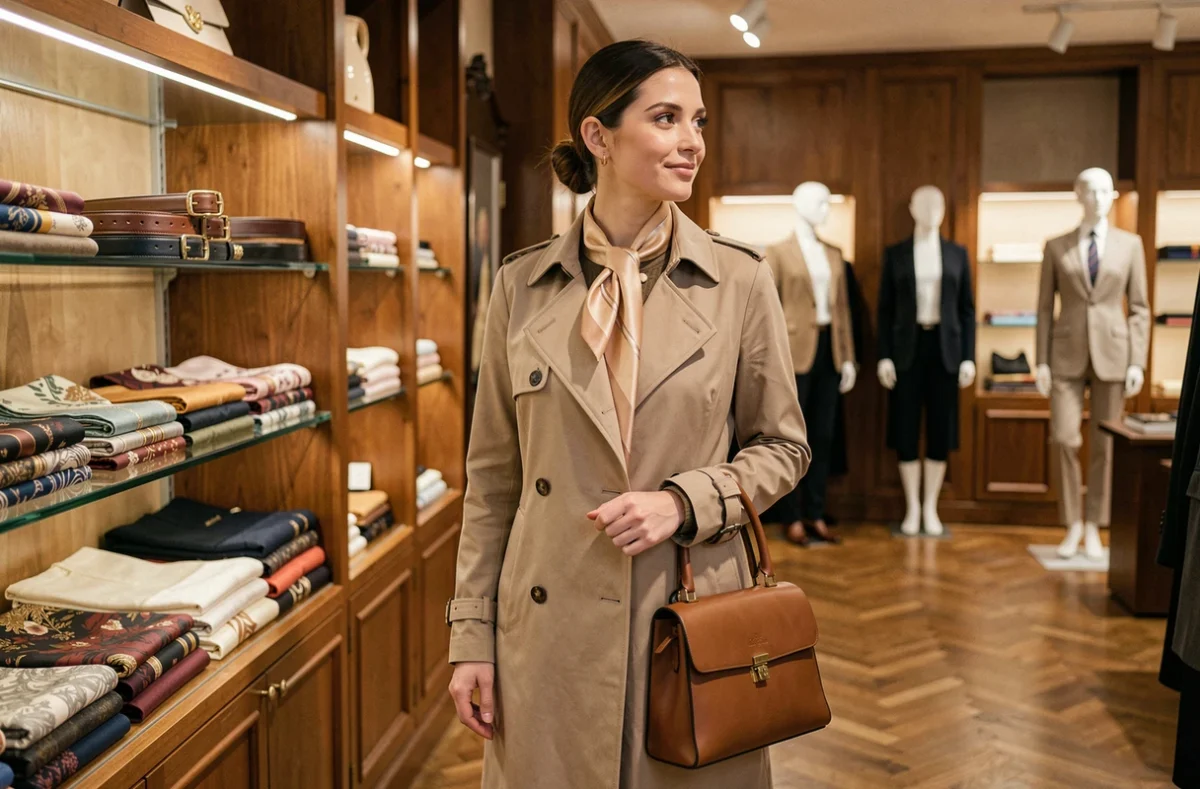
The same pair of jeans and the same sweater can create two radically different looks depending on what you pair them with. Some fashion accessories have a measurable effect on how an outfit is perceived, while others add visual weight without much payoff. To answer the question, it’s better to compare their actual impact than simply list categories.
Visual impact of accessories on a neutral outfit: comparison table
Not all accessories transform an outfit to the same degree. The contrast they create, the visible surface area and their position on the body determine how much they can change the way a look is perceived. Here’s a concise guide.
| Accessory | Body area | Visible surface area | Main effect | Risk of looking overdone |
|---|---|---|---|---|
| Statement earrings (XL) | Face | Small but focal | Draws the eye upward and frames the face | Low when worn alone |
| Contrasting belt | Waist | Medium | Redefines proportions and breaks up a straight line | Moderate |
| Brightly colored bag | Hand / shoulder | Large | Creates a colorful focal point and anchors the look | High when paired with other statement pieces |
| Tied scarf | Neck / hair | Variable | Adds texture and color near the face | Low |
| Watch or bracelet | Wrist | Small | Provides a subtle finishing touch | Very low |
| Jewelry phone strap | Hand / shoulder | Small | A contemporary detail that catches the eye in motion | Very low |
One thing stands out: the closer an accessory is to the face, the greater its impact. Earrings or a scarf tied around the neck attract more attention than a bracelet, despite covering far less surface area. A bag is an exception because of its size, but its impact depends entirely on how much its color contrasts with the outfit.
One detail to keep in mind when making your choices: among Blog 2 Mode’s accessories, you’ll find pieces designed to make a strong visual statement and stand on their own against a simple backdrop.

Leather and metal accessories: how chemical restrictions affect everyday choices
The actual composition of items worn against the skin is a practical selection criterion that’s often overlooked in favor of appearance alone.
The REACH regulation limits nickel release from jewelry and metal accessories that come into prolonged contact with the skin. Items intended for piercings (stud earrings) are subject to a separate, stricter limit. A gold- or silver-plated finish does not exempt an item from this requirement: compliance testing simulates wear before measuring nickel release.
This regulatory requirement has a direct impact on everyday choices. Fashion earrings sold outside regulated channels can cause skin reactions—not necessarily because they contain nickel, but because the amount released exceeds the permitted limit after a few weeks of wear.
Small metal components on textile accessories
Buttons, rivets, belt buckles and bag clasps are also subject to the same restrictions. A leather bag whose buckle regularly touches the skin on your wrist falls under the same regulatory framework as a bracelet. Checking that the metal parts of a textile accessory comply with REACH can help prevent chronic irritation that many people mistakenly attribute to a leather allergy.
Secondhand accessories: an underused style tool
The secondhand market continues to grow, and accessories have a special place in it. Bags, belts and vintage earrings don’t have the same sizing issues as secondhand clothing. The risk of getting it wrong when buying is lower, which helps explain their growing popularity on resale platforms.
Leather pieces often develop more character over time. A well-worn full-grain leather belt creates a textured effect that a new one can’t replicate. Secondhand designer bags remain among the most sought-after items, with demand showing no signs of slowing.
- Vintage brass or silver-tone belt buckles add a raw contrast to a contemporary outfit, provided you check that the fastening is in good condition.
- Secondhand silk scarves can retain their quality for decades if the weave is dense, making them one of the most durable accessories on the resale market.
- Vintage mechanical watches make a strong style statement on the wrist and often offer better value for money than new entry-level models.
Connected accessories and fashion: the line is blurring
Connected devices now use materials and finishes borrowed from fine jewelry. Smartwatches and fitness trackers are becoming visually closer to traditional pieces, to the point where they can be hard to tell apart from a steel bracelet or a classic watch.
This convergence changes how you put an outfit together. A connected bracelet with a Milanese mesh band can replace a piece of wrist jewelry without disrupting the look. Glasses can incorporate digital features while keeping a simple frame. Technology accessories no longer require a style compromise.
One more factor to consider for everyday wear
The question then becomes one of duplication. Wearing a smartwatch and a bracelet on the same wrist creates visual and functional clutter. A connected accessory takes on the decorative role of a traditional piece, freeing up space for another focal point elsewhere in the look, such as statement earrings or a colorful scarf.
Choosing an everyday fashion accessory depends less on its category (jewelry, bag, belt) than on two measurable factors: its position relative to the face and the contrast it creates with the outfit. Add material compliance and the option of buying secondhand, and a style instinct becomes a more considered decision.