
Xavier Morandi has been a university professor and hospital practitioner in anatomy and neurosurgery at the CHU of Rennes since 2005. Born in Pontivy in 1963, he has built his entire hospital-university career within the Rennes establishment, where he has led the neurosurgery department since 2011. His journey illustrates a trajectory where surgical practice, research in neuroanatomy, and educational commitment have constantly intersected.
Image-Guided Neurosurgery: Morandi’s Technical Contribution to Rennes
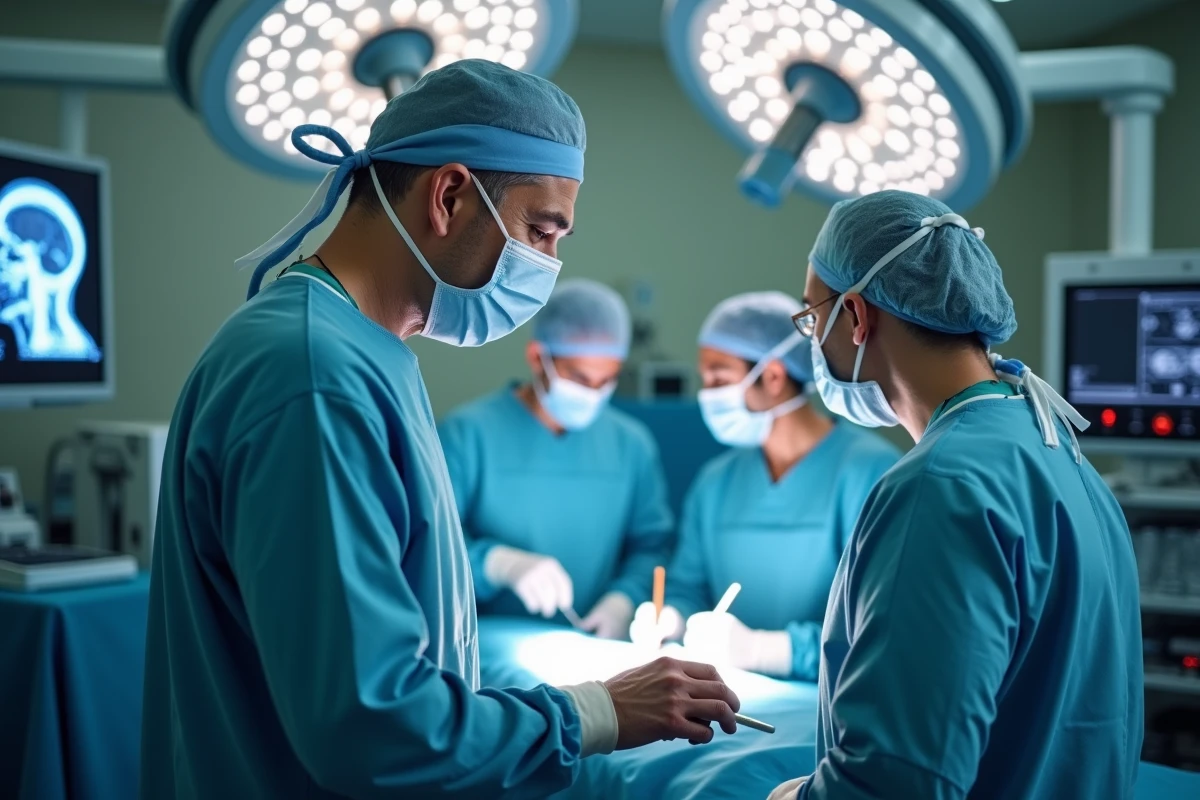
Modern neurosurgery relies on guidance tools that allow the surgeon to precisely locate brain structures during the procedure. Among these tools, neuronavigation and stereotaxy play a central role. The principle: to realign preoperative imaging (MRI, CT scan) with the patient’s anatomy in real-time to guide the surgical action to the millimeter.
Xavier Morandi positioned himself as a regional reference on these techniques as early as the late 1990s. His affiliation with the MediCIS team (Inserm, UR1, UMR 1099 LTSI) confirms a grounding in research applied to computer-assisted surgery. This laboratory works on medical image processing and anatomical modeling, two pillars of contemporary neuronavigation.
The journey of Xavier Morandi in Rennes shows how a hospital-university practitioner can articulate surgical practice and technological development within the same CHU, without necessarily going through the major Parisian centers.
Training Neurosurgeons: Simulation and University Education
Training a neurosurgeon takes about ten years after the start of medical studies. The DES in neurosurgery, which Morandi obtained in 1994, combines intensive hospital internships and gradual acquisition of surgical autonomy. However, traditional training in the operating room is no longer sufficient to cover the complexity of current procedures.
It is in this context that Xavier Morandi co-founded SIMURNe, a simulation structure in neurosurgery affiliated with the CHU of Rennes. Surgical simulation allows interns to practice technical skills on anatomical or digital models before performing them on a patient. The stakes are twofold: to reduce the learning curve and limit perioperative risks.
A Role in the National Selection of Future Specialists
Beyond local training, Morandi has served as a member of the jury for the National Ranking Examinations (ECN). These exams determine medical students’ access to the third cycle and, consequently, to the most sought-after specialties. Participation in this jury reflects national institutional recognition in regulating access to the DES.
His term as vice-dean of the medical faculty of Rennes from 2009 to 2013, followed by his presidency of the scientific council of the same faculty, completes this profile focused on structuring medical education in Brittany.
Research in Neuroanatomy: Publications and Scientific Mobility
Neuroanatomy, the discipline that maps the structures of the nervous system, forms the academic foundation of Xavier Morandi. His habilitation to supervise research, obtained in 2003, has allowed him to oversee doctoral work in this field.
As of his 2018 CV, he had 141 international publications in peer-reviewed journals. This volume of scientific production, accumulated over more than two decades, primarily covers neuroanatomy applied to surgery and brain imaging.
His scientific mobility at McGill University in Canada, lasting twelve months in 2000, constituted an international training step. McGill is recognized for its work in neuroscience, and this stay preceded his transition to a professorship by a few years.
- Intern at the hospitals of Rennes since 1989, then assistant chief resident from 1995 to 1997
- Lecturer and hospital practitioner in anatomy-neurosurgery from 1999 to 2005
- University professor since 2005, first class since 2014
- Head of the neurosurgery department at the CHU of Rennes since 2011
Scientific Council of the Kerpape Fund: Neurosurgery and Rehabilitation
The management of a neurosurgical patient does not stop at the closure of the surgical wound. Post-surgical functional rehabilitation often determines the long-term outcome, especially after the resection of a brain tumor or an intervention on the spinal cord.
Xavier Morandi has served on the scientific council of the Kerpape Endowment Fund, an organization dedicated to innovation in rehabilitation. This positioning directly connects neurosurgery to the functional follow-up of the patient, a continuum that hospital-university pathways do not always formalize.
This involvement goes beyond the operating room and reflects a vision where the surgical act is part of a broader care chain, from preoperative imaging to functional recovery.
Xavier Morandi’s journey in Rennes remains that of a hospital-university practitioner rooted in a territory, who has accumulated clinical, educational, and scientific responsibilities within the same CHU for over three decades. Rennes neurosurgery owes part of its technical infrastructure and its connection to research in medical imaging to him.