
The Lille Flandres and Lille Europe stations are separated by about 500 meters. This journey is taken daily by travelers connecting between a TER and an Eurostar, sometimes with a tight margin between two trains. The distance is short, but the stress of changing stations in an unfamiliar city turns these few hundred meters into a source of real concern.
Accessibility for people with reduced mobility and bulky luggage between the two Lille stations
The walk between Lille Flandres and Lille Europe passes through the Euralille esplanade and the adjacent shopping center. For a fit and light pedestrian, it’s a formality. For a person with reduced mobility or carrying suitcases, the situation deserves closer examination.
Lille Europe station has elevators and escalators documented by SNCF, as well as the Accès Plus service for assisting disabled individuals. The pathway between the two stations remains accessible thanks to the improvements made during the renovation of the Euralille area: widened sidewalks, raised pedestrian crossings, compliant slopes.
However, the route crosses a commercial area that can sometimes be crowded with pedestrians, especially on Saturdays and during sales periods. With a wheelchair or a double stroller, the fluidity of the journey heavily depends on the time and day. Affected travelers are advised to allow a few extra minutes and to contact Accès Plus in advance to arrange assistance from one station to the other.
Those wishing to go from Lille Flandres station to Lille Europe with bicycles face an additional constraint: passing through the Euralille shopping center does not always allow bicycle traffic inside, which requires detouring outside and slightly lengthens the route.

Walking route between Lille Flandres and Lille Europe: signage and real-time information
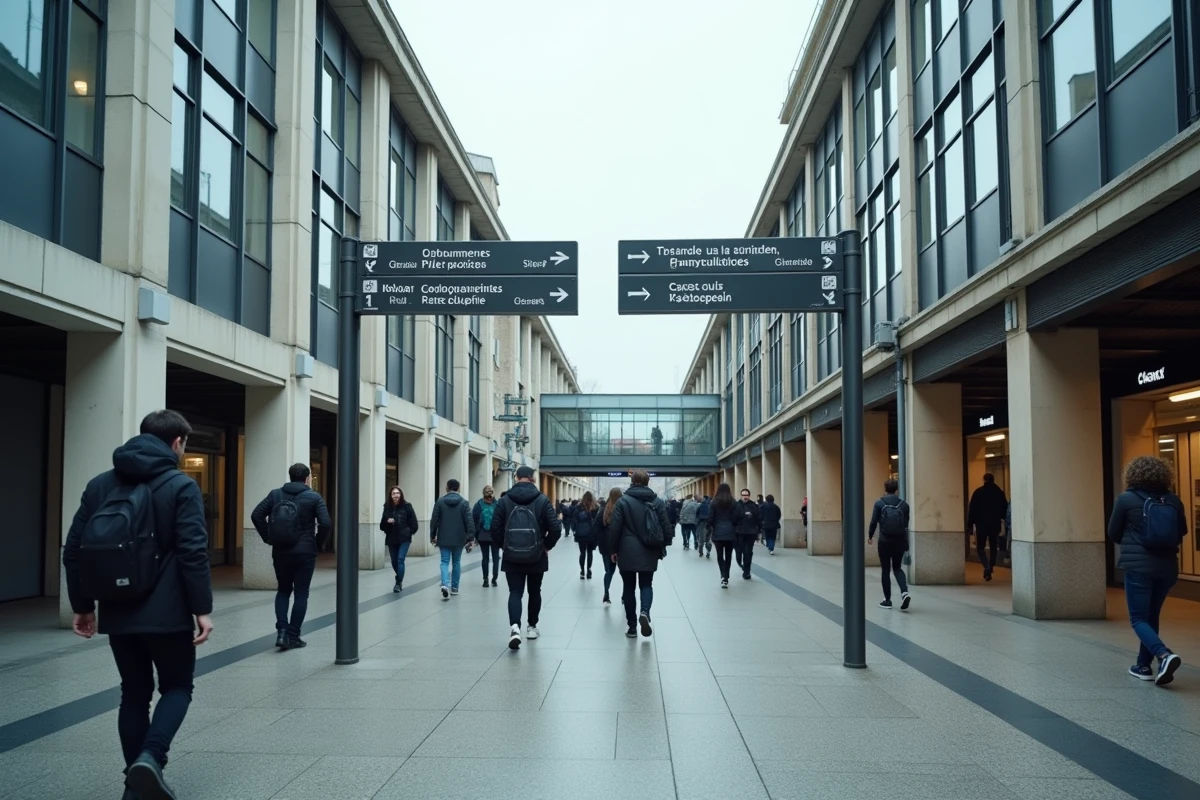
The pedestrian signage has been enhanced during the renovations of Euralille. Signs indicating “Lille Europe” are visible as soon as you exit Lille Flandres, and vice versa. The marking makes the walk intuitive even for a traveler discovering the city.
The journey generally takes about ten minutes at a normal pace. This time increases if you are carrying heavy luggage, if the weather requires slowing down (rain, ice in winter), or if you are crossing the shopping center during peak hours.
Landmarks to follow when exiting Lille Flandres
Upon exiting Lille Flandres through the main exit (towards Place des Buisses), you quickly see the towers of the Euralille district. The route follows an almost straight trajectory:
- Cross Place des Buisses towards the Euralille shopping center, visible to the left
- Follow or cross through the shopping center at the pedestrian level, following the signs for “Gare Lille Europe”
- Arrive at the forecourt of Lille Europe, recognizable by its contemporary glass and steel architecture
The reverse route, from Lille Europe to Lille Flandres, follows the same logic with symmetrical signage.
Metro line 2 between the stations: useful or unnecessary for this journey
Metro line 2 of Ilévia connects “Gare Lille Flandres” station to “Gare Lille Europe” station in a single stop. On paper, it is an alternative to the walk. In practice, the total time by metro often exceeds that of walking.
Getting down to the platform, waiting for the train, traveling one stop, and coming back up takes easily as much time as the ten-minute walk, or even more during off-peak hours when train frequency decreases. The metro becomes relevant in two specific cases:
- Reduced mobility making walking difficult or impossible over this distance
- Extreme weather conditions (heavy rain, snow) making the outdoor journey unpleasant
- Very heavy or bulky luggage (bicycles, large equipment) justifying avoiding pedestrian stairs
The Ilévia app allows you to check real-time train frequencies and make an informed decision. SNCF Connect also includes the pedestrian connection between the two stations in its route calculations, with an estimate of the actual walking time between Lille Flandres and Lille Europe.
Recommended transfer margin for a station change in Lille
The question most travelers ask is not “how to get there” but “how much time to allow.” The distance is known, the journey is simple. The real issue is the margin between the arrival of one train and the departure of the next.
For a traveler without specific constraints, a margin of about twenty minutes between the two trains offers reasonable comfort. This estimate includes the time to disembark from the first train, cross the hall, walk, and access the platform of the arrival station.
Factors that can extend transfer time
SNCF delays are the primary factor of uncertainty. A train arriving a few minutes late at Lille Flandres compresses the transfer margin. Travelers connecting to Eurostar must also anticipate the security check at Lille Europe, similar to that of an airport, which adds a significant delay.
Peak travel periods (school holidays, long weekends) increase the crowding in both stations and along the pedestrian route. The line at the Eurostar security check can then stretch. The available data does not provide an average passage time for this check, as it varies by day and hour.
Allowing for a wider margin when connecting to an Eurostar remains the most reliable precaution. Missing a regional TER can be easily compensated for with the next train. Missing an Eurostar to London or Brussels has much heavier financial and logistical consequences.